
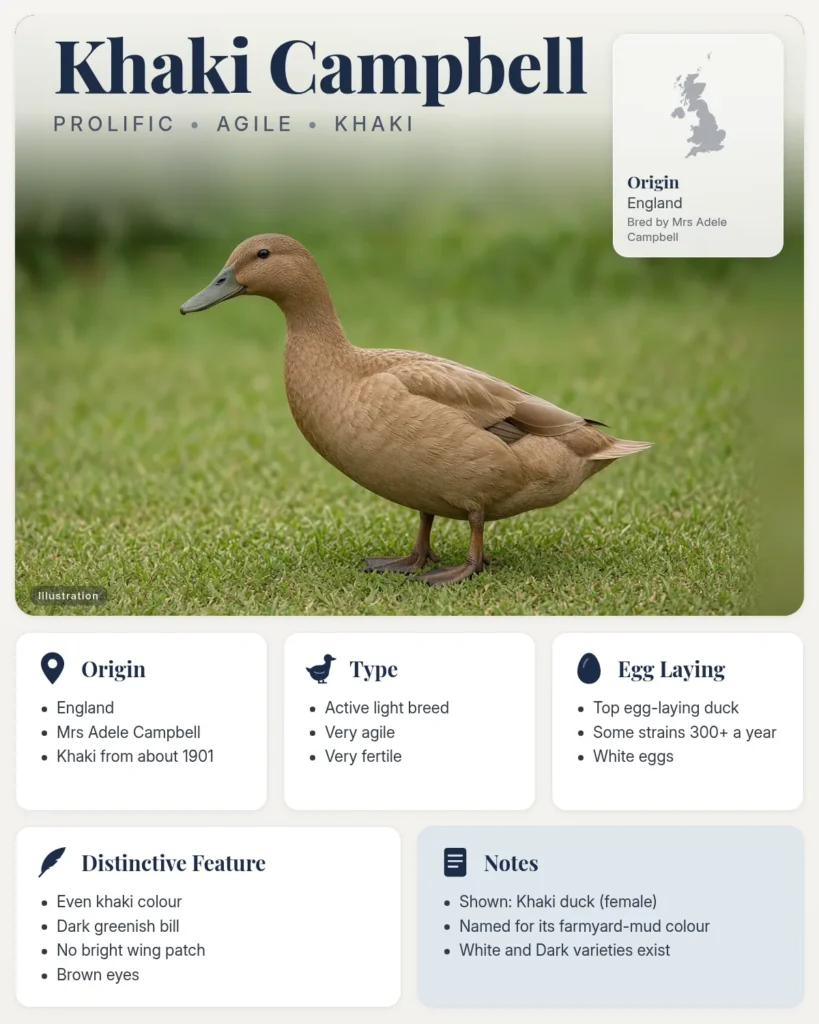
History & Origin
The Khaki Campbell was developed in the United Kingdom during the late 1800s by Adele Campbell. Her goal was to create a breed that excelled in egg production while remaining hardy and easy to manage. By crossing Indian Runners, Rouens, and Mallards, she successfully established a breed that would go on to set world records for egg laying. The breed was officially introduced in 1898 and has since become a staple for poultry keepers focused on high-yield egg production.
Temperament & Behavior
Khaki Campbells are known for being highly active, energetic, and sometimes a bit high-strung. They are busy birds that prefer to spend their day foraging and staying on the move. While they are not as naturally docile as Pekins, they are intelligent and can become quite comfortable with their keepers if handled regularly. Their energetic nature makes them excellent foragers, always on the lookout for bugs and greens, which keeps them productive and healthy.
What Makes Them Special?
The breed is named for its modest but beautiful khaki-colored plumage, which provides excellent camouflage in natural settings. They have a sleek, streamlined body and a graceful presence. What truly makes them special, however, is their legendary productivity. They are widely regarded as the most efficient egg-layers in the duck world, capable of outperforming many chicken breeds. Their ability to maintain high production without needing specialized care is a hallmark of the breed.
Egg & Utility Facts
From a utility perspective, the Khaki Campbell is a world-class egg layer. They are famous for consistently producing up to 300 large white eggs per year, with some exceptional birds even exceeding that number. They are a lightweight breed, which means they have lower feed requirements than larger ducks, making them highly economical. Their hardiness allows them to continue laying even in cooler weather, providing a reliable year-round source of eggs for any homestead.